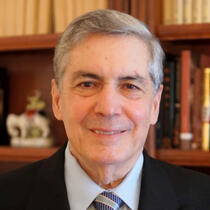
Ambassador Oscar R. de Rojas
Potential candidate for U.N. Secretary-General________________________________________________
Ambassador Oscar R. de Rojas is a Latin American diplomat and former senior United Nations official whose career spans more than four decades of international diplomacy and multilateral service.He has served as Chairman of the Second Committee of the United Nations General Assembly, as President of UNCTAD’s Trade and Development Board, and as director of the Financing for Development Office of the UN Department of Economic and Social Affairs.Amb. de Rojas was the Executive Secretary of the International Conference on Financing for Development, held in Monterrey, Mexico, in 2002, and of its follow-up conference in Doha, Qatar, in 2008. These responsibilities involved sustained engagement with Member States, the United Nations system, international financial institutions, private businesses, non-governmental organizations and other stakeholders in support of effective multilateral negotiation and consensus-building.His wider career includes leadership roles in international cooperation initiatives, service in humanitarian assistance entities and university teaching in international relations, development economics and the United Nations system.
During his forty-five years in positions related to the United Nations and the UN system, both as a diplomat and as an international civil servant. Mr. de Rojas’ effective leadership, managerial, diplomatic and inter-personal skills, as well as his demonstrated integrity, impartiality and transparency, have been well known in UN circles and earned him the respect of countries from all countries and regions. ____________________________________________________________CVBefore joining the United Nations in 1999, Mr. de Rojas served for 27 years in the Venezuelan Foreign and Civil Services, attaining the rank of Ambassador, and holding senior-level posts in that country’s diplomatic missions at UN headquarters, in both New York and Geneva, in Paris, as well as in the Ministry of Foreign Affairs in Caracas. He attended, in one capacity or another, every UNGA session between 1974 and 2019.Professional Experience – Governmental and Diplomatic• Special Assistant to the Venezuelan Minister of State for International Economic Affairs (1974-77). This Minister served as co-Chairman of the Paris conference on International Economic Cooperation, convened by the president of France after the oil shocks of the 1970s, that was widely referred to as the “North-South Dialogue”.• Director of Promotion of Non-Traditional Exports at the Institute of Foreign Trade of the Ministry of Foreign Affairs in Caracas (1977-1980).• Director for International Technical Cooperation in the National Office of Coordination and Planning (1980-83), in coordination with the Foreign Ministry.• Minister-Counsellor at the Mission of Venezuela to the UN in New York (1983-1987). In 1986 he was elected Vice-Chairman of the G.A.’s Second Committee.• Ambassador and Deputy Permanent Representative of Venezuela to the international organizations in Geneva (1987-1990). In 1989 he was elected President of UNCTAD´s Trade and Development Board, during which time important resolutions were adopted about the streamlining of that organization.• Director-General for International Economic Affairs and Cooperation at the Foreign Ministry in Caracas (1990-1993).• Special Adviser to the Executive Secretary of the Latin American Economic System (SELA) (1993-1995) both at its Caracas headquarters and at its U.N. observer mission in New York.• Ambassador and Deputy Permanent Representative of Venezuela to the United Nations in New York (1995-1999). In 1997 he was elected Chairman of the G.A.’s Second Committee and oversaw the adoption of important resolutions, including one on the reform and revitalization of ECOSOC and economic sectors of the UN (50/227), and the one launching the Financing for Development Process.Professional Experience - International Civil Service• Director of DESA’s Financing for Development Office (1999-2009). In 1999 Mr. de Rojas was recruited by the UN Department of Economic and Social Affairs to organize and manage the new office created, at the request of the G.A., to provide support to the preparations for the conference on Financing for Development.• Executive Secretary of the Financing for Development (FfD) Conference. The conference was finally held, at the summit level, in Monterrey, Mexico, in March 2002, which included the adoption of the Monterrey Consensus. The Consensus had entailed complex negotiations not only among member states, but also with other agencies of the system, particularly the Bretton Woods institutions, who were invited by the G.A. to participate in the conference as “equal partners”; the business sector and civil society were also actively involved. Mr. de Rojas’s office acted as the central liaison point with all of these entities.• As head of the FfD office, Mr. de Rojas was then charged with coordinating and implementing the follow-up or “staying engaged” mechanisms set up for the FfD process, consisting of annual joint meetings of ECOSOC with the major entities involved, including the World Bank, IMF and WTO. These joint meetings took place regularly every year, just prior to the Council’s annual substantive session,• Executive Secretary of the first follow-up conference on Financing for Development held in Doha, Qatar, in 2008, where the Doha Declaration was negotiated and adopted. .Professional Experience – Academic and Non-Profit• Professor of Development Economics and International Relations (1972-74) at the Andrés Bello Catholic University in Caracas, Venezuela.• Consultant to the Pontifical Council for Justice and Peace (2000-05).• Adjunct Professor of United Nations studies and of Latin American Development issues at Long Island University, Brookville, Long Island, New York (2009-12)• Director of International Relationships of Long Island University (2012-2015).• Visiting professor at the summer program on International Relations of St. John’s University held in Rome, Italy. (2011-2013).• Permanent Observer of the Sovereign Order of Malta to the UN, New York (2015-19). The Order of Malta is an entity devoted to providing humanitarian assistance to poor, sick and displaced persons around the world.Education and Honors• Bachelor of Science degree in Electrical Engineering from Louisiana State University, Baton Rouge, Louisiana.• Master of Arts degree in Economics from Columbia University, New York.• Master of International Affairs degree from Columbia University, New York.• International Diplomats visitors program, sponsored by the United States government.• Certificate of International Development issues, World Bank.• Certificate of International Economic Studies from the Institut International d’Administration Publique, Paris, sponsored by the French government.• Order of the Rio Branco, Brazil• Order Bernardo O’Higgins, Chile• Grand Cross of the Order of Merit, Sovereign Order of Malta• Constantinian Order of St. George, Spain• Grand Cross of the Order of Sr. Gregory the Great, Holy See• St. Vincent de Paul Medal, St. John’s University, Long Island, N.Y.Other personal informationMr. de Rojas was born in Havana, Cuba, and moved with his family to Venezuela as a child. He is fluent in Spanish, English and French.Amb. de Rojas currently lives in Florida, USA. He has two sons and two grandchildren.
________________________________________________UN Vision StatementWhy am I suited?I believe that I am especially well-suited to fulfill the functions of Secretary-General of the United Nations with the highest level of competence, efficiency, integrity and distinction. As can be seen from the short biographical note above, I have been closely associated with the work of the United Nations, both at the inter-governmental and secretariat levels, for over four decades, most of it relating to activities in, but not limited to, the economic and social development fields. I know the Organization well, with all its strengths and weaknesses, and its potential for success, as well as the great duties and responsibilities that befall upon the function of Secretary-General.As previously indicated, before joining the United Nations in 1999, I had served for 27 years in the Venezuelan Foreign and Civil Services, attaining the rank of Ambassador and holding senior-level posts in Venezuela's diplomatic missions at the UN headquarters, in both New York and Geneva, in Paris, as well as in the Ministry of Foreign Affairs in Caracas, all of this time specializing in multilateral diplomacy.I then had the privilege of serving for ten years (1999-2009) as Director of the new DESA Financing for Development Office, and became Executive Coordinator of the International Conference on Financing for Development held in Monterrey, Mexico in March 2002, as well as Executive Secretary of the Follow-up Conference held in Doha, Qatar, in 2008. On both of those occasions, which involved delicate negotiations among governments and intense, complex consensus-building work with specialized agencies, business and civil society entities, my leadership, managerial and diplomatic skills were put to the test and proven to be very effective.I have thereby demonstrated strong managerial and leadership abilities, always keeping a strategic and integrated vision, including providing, when appropriate, direction in intergovernmental processes with a knowledge of issues related to the three main “pillars” of the United Nations. I have also proven a keen ability to promote participation of, and build consensus with, nongovernmental stakeholders and to undertake responsibility for large, multidisciplinary and multicultural teams.Former Secretaries-General and senior UN officials know of my work well. Throughout my UN career, I believe I gained the respect and trust of delegations from all regions and groups because of my transparent style, impartiality and integrity, as well as my effective inter-personal and negotiating skills and ability to address especially complex and demanding situations.What do I see and hope for the future?I see an organization that works much better and more effectively and efficiently in all its three main pillars: peace and security, development and human rights. I see a U.N. that never loses sight of the foundational principles which inspired its creation and were enshrined in the Charter, as well as in subsequent important agreements, such as the Universal Declaration of Human Rights.I know that great efforts have been devoted over the years to the reform and revitalization of the U.N., its bodies, agencies and Secretariat departments. Having myself been a senior official in the organization and dealt with these issues for a long time, I know of the U.N.’s weaknesses and challenges, and its great potential for improvement. This applies firstly at the inter-governmental level, regarding the various bodies to which substantive support must regularly be provided by the Secretariat. There is a need to continue to revisit these bodies and mechanisms and either strengthen or streamline them, as appropriate. One must never be afraid of change -and, when necessary, of simplification or outright elimination- having in mind the need to rationalize costs and avoid unnecessary overlap and duplication.The main intergovernmental bodies –General Assembly, Security Council, ECOSOC—all require continuing review and adaptation to current realities and needs. Much has been done in this regard, and much more can and should be done -as indeed GA Resolution 79/327 did- without necessarily having to resort to Charter amendments which can be controversial and time consuming.Just as intergovernmental bodies need continuous review and reform, so do the Secretariat departments and the multitude of UN bodies, agencies and pogrammes. When one opens the UNSG website titled “Leadership Team”, one can count up to 180 positions, in terms of USGs, ASGs, heads and deputy heads of UN agencies, programmes and institutes, Special Envoys, Special Advisers, etc. From this large group, a smaller executive group of 45 seniormost-level officials is drawn, called the “Senior Management Group”. Many of these positions were established by inter-governmental mandates, but others possibly were not. There should therefore be room for review of these posts, in the context of present needs and constraints, keeping in mind the need to strengthen geographical, gender and linguistic balance. The work of all UN officials should be evaluated regularly, rigorously and transparentlyMobilizing political willNo attempts at UN reform, whether of its governmental bodies or its secretariat structure will be possible if there is no political will on the part of member States. Like many of you, I have been approached by persons not knowledgeable of how the UN really works with remarks such as “The UN has done nothing to prevent war in such and such a place”, or “The UN just stands by while human rights are blatantly violated in such and such a country”, or “the UN does nothing to prevent malnutrition and end poverty in those very poor countries.” And we always reply: The UN does only as much as what its member States want it to do, not more, not less. The UN (and its Secretary-General) do not have by themselves the authority or the means to stop wars, punish human rights abusers, or eliminate dire poverty. These actions can only be the result of concerted, willful action (and allocation of the necessary resources) on the part of member States. We need more political will on the part of all in order to arrive at the type of UN that most of all wish to have.And what type of UN is that? We need to look no further than the Charter to get the right bearings. The founding drafters in San Francisco were still recovering from the shock of two world wars that during their lifetime had brought “untold suffering to mankind” and witnessed the most barbaric violations of human rights. They were determined that such things should never happen again and to design an organization to help prevent them. They and their governments had political will.It is now up to us, a few generations later, to decide if we want to keep, update and strengthen this organization, or if we want to condemn it to irrelevance and perhaps substitute it with something else. In the final analysis, it is a clear choice.The importance of an ethical approachI strongly believe that everything the U.N. and UN officials do must be grounded on an ethical, values-based approach. Again, to find those ethical values we need to look no further than to the Charter, the Universal Declaration of Human Rights and all other relevant resolutions, declarations and programmes adopted by the UN since 1945. When we look there, what do we see? A fundamental belief in the dignity of the human person and the inviolable rights which derive from that dignity. We also see an aspiration for nations to cooperate to promote the common good of all humanity, upholding timeless values such as justice, freedom and solidarity. I am convinced that true peace is not possible if it is not built upon those basic values. Thus, it is good to be pragmatic when addressing the many challenges the world faces, but at the same time we should never lose our dose of idealism.